
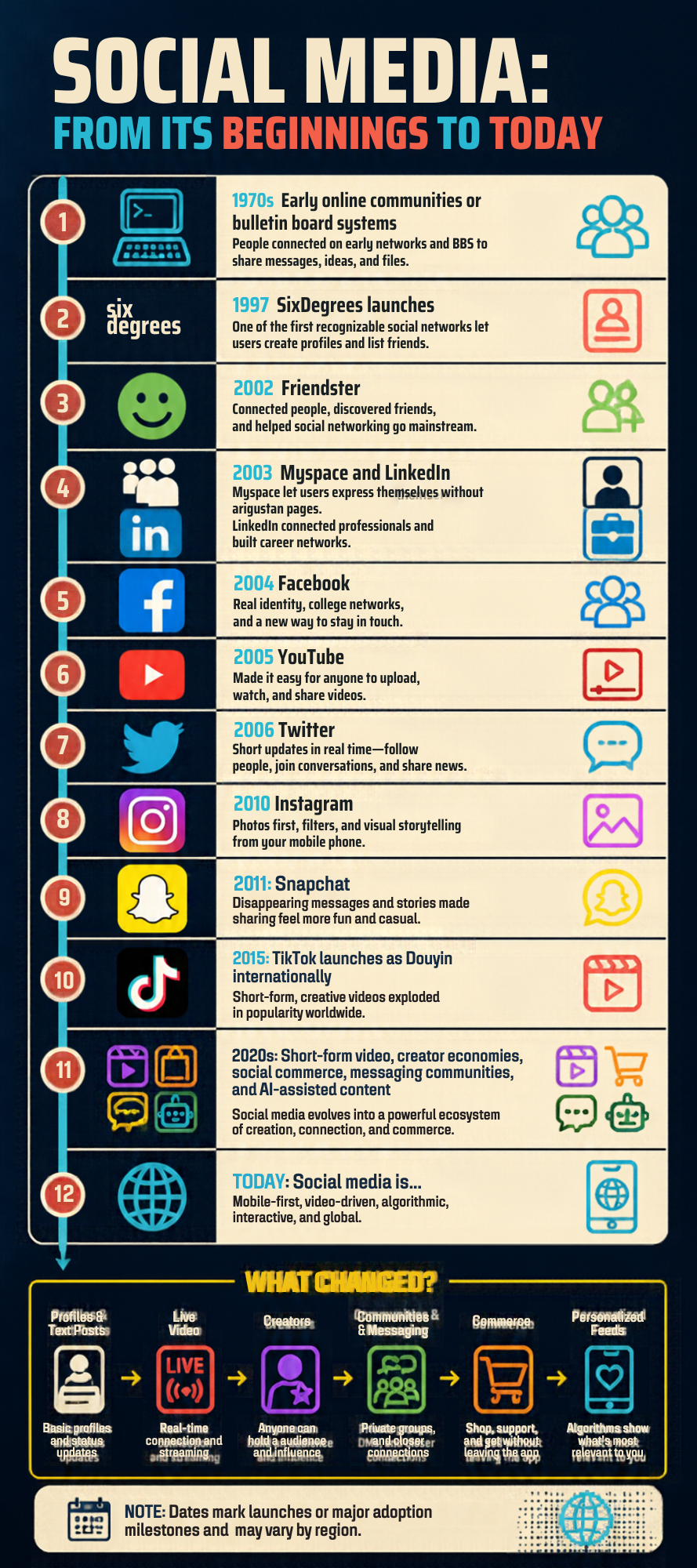
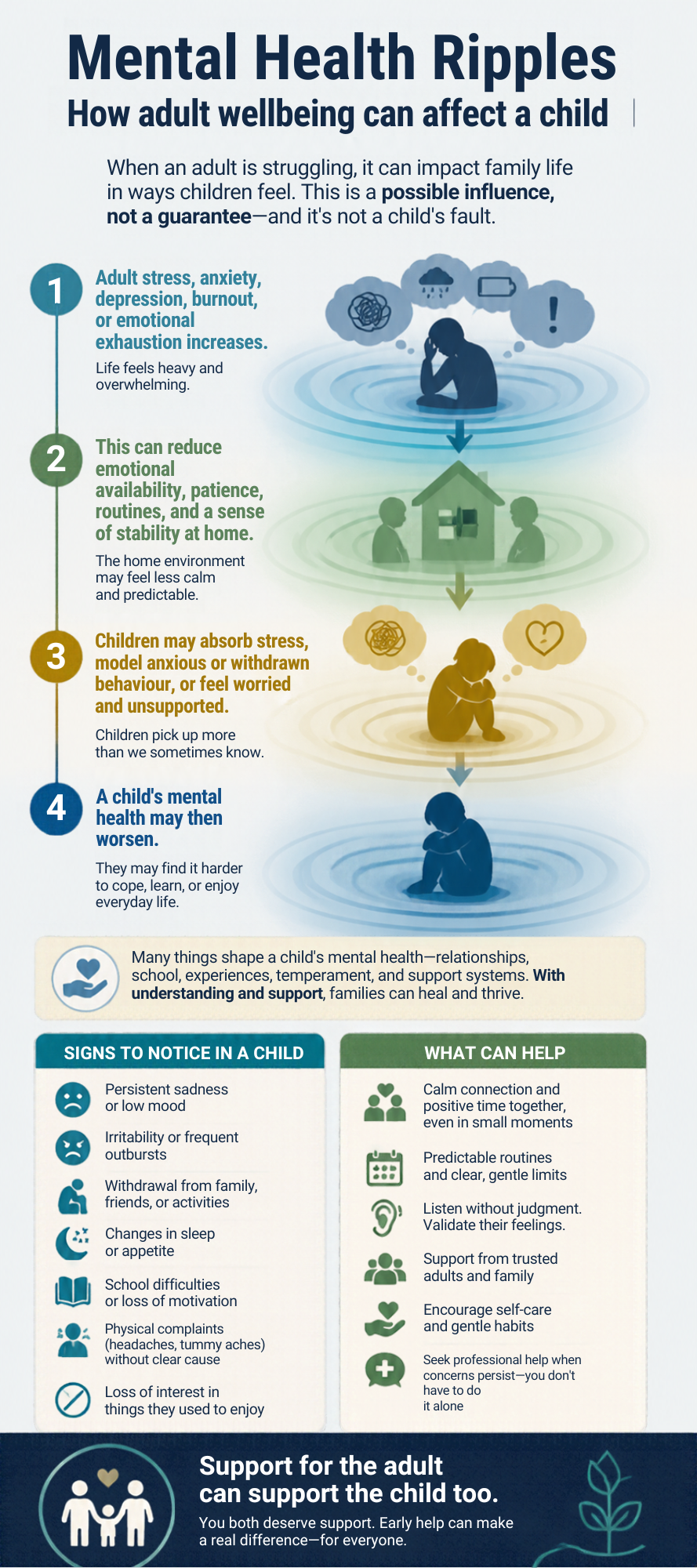
The Top infographic looks at how each stage of social media has evolved, from its infancy in the 1970s to the present day in the AI era. I created this infographic to present the timeline in an easy-to-follow way. The bottom right infographic I made is a visual piece that is common knowledge of how an adult mental health crisis can ripple down into a child. If we let the stress get to us, and tell that a child can feel the effects. We are often taught that children are like sponges, and I believe that to be true. I am a product of it. Growing up, I didn’t really talk about mental health because I didn’t know how to. Nobody taught me how to until I became an adult and started going on social media.
One thing we noticed when people first started using social media was that it began in the 1970s on bulletin board systems (Christensen 1978). This started the trend of people being able to say what they want with no repercussions. Then, the first social network to launch was SixDegrees (SixDegrees, 1997). After that, we started to see more and more modern social networks emerging.
In 2011, we saw the effects on teenagers all over the world. The movie that demonstrates it really well is called Cyberbully, which stars Emily Osment and Kay Panabaker (Biname, 2011). This film is about what really happens to someone who is being cyberbullied. To the point where the main character attempts to take her own life (Biname, 2011). The film also shows that the mom, Kris Hillridge, played by Kelly Rowan, is dealing with the stress of her divorce. This is what I mean when the effects of adult mental health affect the youth.
When we watch the YouTube trailer below, we see that Taylor is not the only one struggling. Her mom is stressed and takes it out on her, too. This goes into what Dr. Candice Odgers found in her research: that depressed girls tend to go on social media and get more depressed than the other way around (Lind, 2026). It also depends on the stress adults place on teens, which is a problem.
Resources:
Biname, C. (Director). (2011, July 17). Cyberbully [TV Movie]. Muse Entertainment Enterprises.
ByteDance. (2016, September). About TikTok: Company newsroom and history [Corporate backgrounder]. TikTok. https://newsroom.tiktok.com/
Christensen, A. (1978). Computerized Bulletin Board System (CBBS) [Historical documentation]. Computer History Museum. https://www.computerhistory.org/
Friendster. (2002). Friendster company launch and overview [Corporate history archive]. Friendster.
Instagram, LLC. (2010, October 6). Our story from the beginning [Company info]. Meta. https://about.instagram.com/
LinkedIn Corporation. (2003, May 5). About us: LinkedIn corporate history [About page]. LinkedIn. https://about.linkedin.com/
Lind, M. N., Schueller, S. M., & Odgers, C. L. (2026). We don't know how social media bans will affect youth, but we're doing it anyway! Frontiers in Developmental Psychology, 4, Article 1805989. Retrieved October 2, 2026, from https://doi.org/10.3389/fdpys.2026.1805989
Meta Platforms, Inc. (2004, February 4). Company info: Meta [Press release/About page]. Meta. https://investor.fb.com/
MySpace. (2003, August). MySpace main page and user network launch [Archived media]. MySpace.
SixDegrees. (1997). SixDegrees platform launch and social network model [Archived documentation]. SixDegrees.com.
Snap Inc. (2011, July). Snap Inc. company history and milestones [Corporate backgrounder]. Snap Inc. https://newsroom.snap.com/
X Corp. (2006, July 15). About X: Our history and milestones [About page]. X. https://about.x.com/
YouTube. (2005, December 15). YouTube official public launch [Company history]. Google. https://blog.youtube/