Beyond the ScreenWe haven’t studied social media enough to say that banning youth will improve mental health
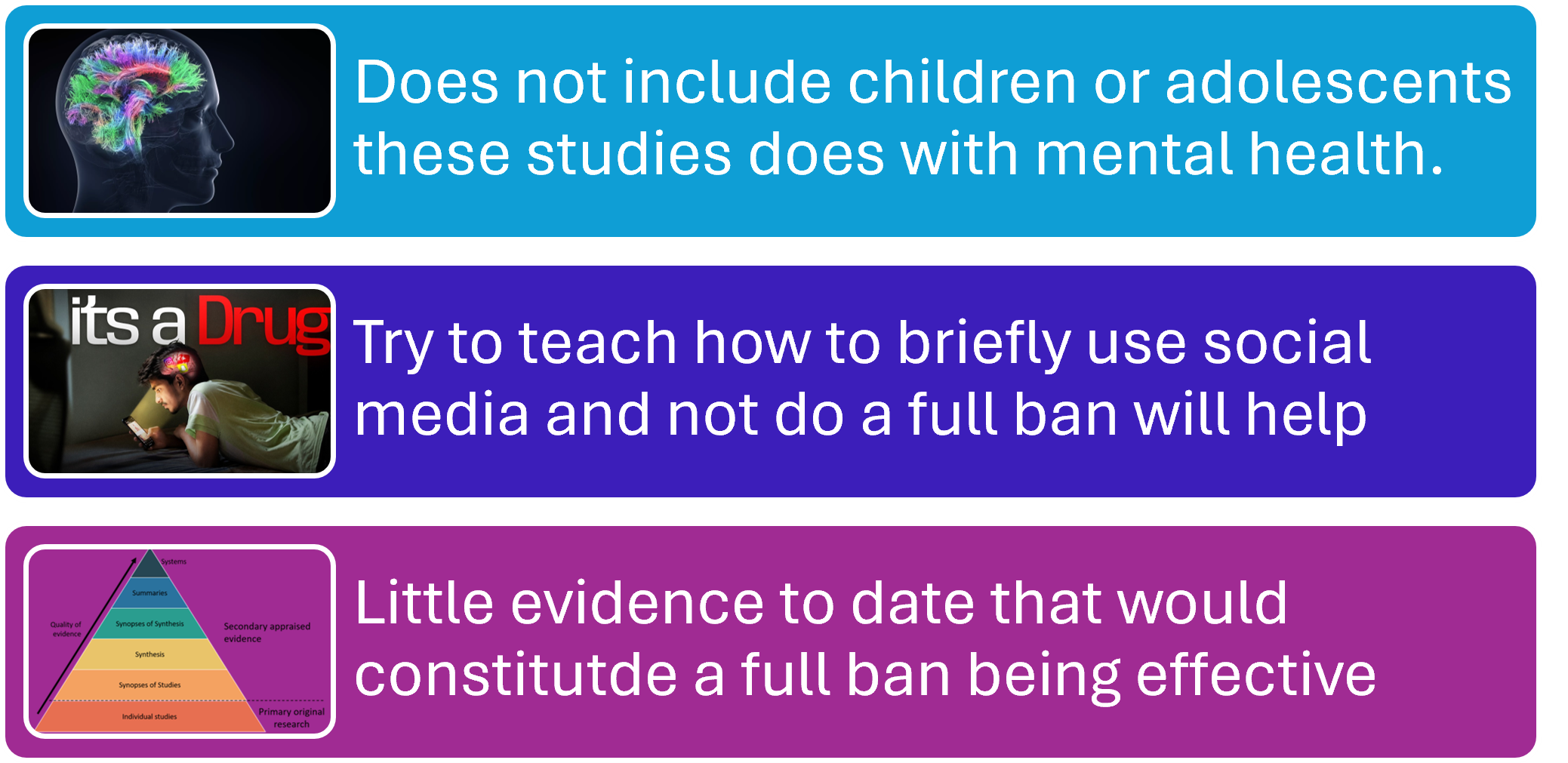
When we think of social media, some may think that a lot of people who use social media are coming in with mental problems. The obvious answer is that we should ban the youth from going on them, right? Let’s look at one study in mind. It’s called “We don’t know how social media bans will affect youth, but we’re doing it anyway.” It was published in Frontiers in Developmental Psychology in May 2026. I created a smart art in Microsoft Word that found three interesting things that we could learn from.
The main issue is that children and adolescents are rarely included in these studies. Of all the studies Monika Lind, Stephen Schueller, and Candice Odgers examined, the youngest participant was 16 years old (Lind, 2026). This is a problem because we aren’t looking at the cause. We’re hoping that if we ban them from using it, it will be fine. Wrong. I don’t know if you remember being a kid, but there were a bunch of times where teenagers snuck out or did things they weren’t supposed to. Laws won’t stop that.
The second is that we should try to improve the world. Kids aren’t going to understand how to use social media properly. So, we as adults should be teaching them how. We need to make sure that they aren’t abusing it. On TikTok, the minimum age to go live is 18, but there are kids every day who try to skate around the rules. Originally, it was 16, but TikTok changed it to 18 (TikTok Support, 2026). Even in Australia, where they have a complete ban for those under 16, there are still 15-and-under on social media. This is anecdotal, as a few mutuals I have from Australia have told me.
One thing that the Black Dog Institute from Australia brings up is that young people facing mental health challenges often turn to social media to find resources and cope (Christensen, 2024). So why are we going to take something away that helps?
Lastly, I want to point you and point to the video to the right; she explains. How Adults broke the internet, and we are going to punish the youth for it (TED Talk, 2026). So, I asked why we are going to take away a valuable resource for kids to express their freedom of speech while we protect them online. One way is to teach in a modern way. The truth is that social media is not going anywhere. So why should we punish the good while taking away the bad.
References:
Christensen, H., Slade, A., & Whitton, A. E. (2024). Social media: The root cause of rising youth self-harm or a convenient scapegoat? Medical Journal of Australia, 221(10), 524–526. Retrieved October 2, 2026, from https://doi.org/10.5694/mja2.52503
Lind, M. N., Schueller, S. M., & Odgers, C. L. (2026). We don't know how social media bans will affect youth, but we're doing it anyway! Frontiers in Developmental Psychology, 4, Article 1805989. Retrieved October 2, 2026, from https://doi.org/10.3389/fdpys.2026.1805989
TED Talk. (2026, July 2). Why a Social Media ban Won’t Save teens Candice Odgers TED [Video]. YouTube.
TikTok support. (2026). Tiktok.Com. https://www.tiktok.com/support/faq_detail?id=7581820708762753548&category=web_account